A place of
memory for
your agents.
Gradatum is a self-hosted, embedded memory backbone for multi-agent AI systems. It cures memory rot in LLMs and lets Claude, Gemini, Codex and your home-grown agents share what they know — across sessions, across machines, across runs.
« Loci sunt, in quibus imagines collocantur. »
LLMs forget. Agents reinvent the wheel every session. Teams of agents can't share what they learn.
- SaaS lock-in — your memory hosted on someone else's server
- Heavy stacks — Postgres + pgvector + Neo4j just to remember things
- Built for humans, not agents — no ACL, no multi-tenancy, no MCP
- Transient context, not persistent KB — forgets between sessions
One Rust binary. SQLite + Markdown on disk. No PostgreSQL. No Redis. No SaaS. Pluggable LLM (or none). Multi-vault. Hierarchical ACL. Hybrid search — BM25 (SQLite FTS5) + semantic (cosine) + PageRank. The Markdown files are the source of truth — not the index.
The Gradatum approach
| Embedded | One Rust binary. No PostgreSQL. No Redis. No external services. apt install and you're running. |
| Self-hosted | Your memory, your machine. No telemetry. No vendor lock-in. |
| LLM-agnostic | Plug any OpenAI-compatible backend (Ollama, vLLM, llama.cpp, OpenRouter, Anthropic) — or run heuristic-only with no LLM at all. |
| Multi-vault | Separate main from staging and bench-* vaults for testing, migration, A/B prompts. Atomic swap when ready. |
| Hierarchical ACL | Bearer-scoped access to memory loci. Two built-in presets: hierarchical (default) — admin and studio with full access, plus a main-agent orchestrator and typed sub-agents each scoped to their own read/write patterns; flat — a single consumer, a single locus, no isolation. Or point --preset at your own TOML file. |
| Multi-storage | OpenDAL abstraction — local filesystem (default) and S3/R2-compatible object storage available since v2.0.0. Azure, GCS planned on the same abstraction. The startup check that once refused NFS was removed in v2.0.0; POSIX lock incompatibility under concurrent writers is now the deploying operator's call to make. |
| Markdown truth | Notes are Markdown files with YAML frontmatter. Readable by humans and by cat. The database is an index, not the source of truth. |
| Hybrid search | BM25 (SQLite FTS5) + semantic search (cosine brute-force; ANN (sqlite-vec) optional). PageRank graph + reranker abstraction (no-op by default; cross-encoder ONNX optional). Multi-signal fusion via RRF (Reciprocal Rank Fusion). |
One binary. Four planes. Markdown on disk.
A stateless façade speaks HTTP and MCP to your agents. A worker drains a SQLite-backed queue. One vault per instance is the default — staging and bench-* vaults are first-class for migration and A/B testing.
        AI agents · coding assistants · orchestrators
              ↓  MCP / HTTP / CLI  (RFC-0003: :19090)
        ┌─────────────────────────────────────────┐
        │  gradatum-server                        │  stateless façade
        │  /api/v1  /mcp  /sse  /health  /admin  │
        └────────────────┬────────────────────────┘
                         ↓  async queue · Apalis (SQLite, lease 5min)
        ┌─────────────────────────────────────────┐
        │  gradatum-worker                        │  curator + maintenance
        └────────────────┬────────────────────────┘
                         ↓  DATA PLANE (19 of 28 product crates)
        ┌─────────────────────────────────────────┐
        │  core  markdown  vault  storage  index  │
        │  search  queue  cache  chat  curator     │
        │  embed  engine  acl-policy  acl-auth     │
        │  auth  dto  db-sqlite  warden  gateway  │
        │  [SQLite FTS5 · cosine · reranker (no-op)  │
        │   Apalis · OpenDAL · llama.cpp · rmcp]  │
        └────────────────┬────────────────────────┘
                         ↓  CLIENTS
        ┌─────────────────────────────────────────┐
        │  gradatum-mcp-stub  (stdio→HTTP proxy, source-only)  │
        │  gradatum CLI                           │
        │  gradatum-sdk-rs                        │
        │  gradatum  (umbrella SDK facade)        │
└─────────────────────────────────────────┘ How a note lives.
A note in Gradatum follows two pipelines: one when it's written (ingested + understood + indexed), one when it's searched back. Both run on the same machine, in milliseconds, with zero SaaS round-trip.
Write
an agent submits a note- 1
Authenticate the agent
The agent presents an API key. Gradatum exchanges it for a short-lived JWT used for the rest of the session.
api-key (chmod 600) ·
POST /auth/exchange· JWT 24 h - 2
Accept and queue
The note is queued. The call returns immediately — the agent doesn't wait for indexing.
POST /api/v1/vault_write· 202 Accepted - 3
Curate (or skip)
A local LLM classifies the note into a canonical section. Skipped when the agent already provides one.
Qwen3-4B local · skipped when
section_hintset - 4
Extract the title
If the note starts with a heading, that becomes the title — a stable identifier for cross-references.
H1 markdown extract · stored in
notes.title - 5
Compute meaning (embedding)
The text is turned into a numeric fingerprint of its meaning. Two notes on the same topic land near each other — even with no shared words.
bge-m3 · 1024-dim vector · local inference
- 6
Connect the dots (wikilinks)
Cross-references inside the note become edges in the vault's graph. Backlinks build naturally over time.
B5 post-curate ·
[[Note]]→ graph tablenote_links - 7
Persist everything
Text, vector, full-text index, graph edges — all written in a single atomic transaction.
SQLite WAL · FTS5 · BLOB f32 · ULID keys
- ✓
Ready to be recalled
The note is live and searchable.
end-to-end ~0.5–2 s · dominated by embedding
Search
an agent asks a question- 1
Reuse the auth
The JWT is refreshed automatically when it nears expiry. Most search calls pay no auth cost.
auto-refresh · under 30 % TTL remaining
- 2
Receive the query
The agent sends a natural-language query and optional filters.
POST /api/v1/vault_search· section, tenant, limit, include_downgraded - 3
Search by words
Classic full-text search returns notes containing the query terms. Fast and exact — blind to synonyms.
SQLite FTS5 · BM25 ranking
- 4
Search by meaning
The query is matched against note fingerprints by similarity. Returns notes that mean the same thing — even with no shared words.
bge-m3 query embed · cosine similarity in-process
- 5
Reconcile both rankings
The two ranked lists are merged into one — without needing to calibrate scores between them.
Reciprocal Rank Fusion · k = 60 · stable sort
- 6
Boost by context
Recent notes get a small bump. Notes linked to by many others get another.
composite = rrf × (1 + α × recency) × (1 + β × pagerank) · α=0.2 β=0.1
- 7
Re-rank the top results
A neural model rescores the top candidates with deeper understanding. Off by default — opt-in.
reranker abstraction (no-op by default) · cross-encoder ONNX optional · feature
onnx-reranker - 8
Build readable snippets
A short excerpt around the match is extracted — the agent gets context, not just an ID.
FTS5 native
snippet()· « match » - ✓
Return the top-N
Each result carries id, score, title, snippet, section, tags.
end-to-end ~50–200 ms (no reranker) · ~150–400 ms (with)
Six levels, named with care.
Borrowed from Cicero's ars memoriae: agents place their memories in loci, mental locations of an imagined palace. Agents don't share rooms — they share places of memory.
- Vault
- The technical backing store (SQLite FTS5 + Markdown). Multi-vault first-class — main + staging + bench-*.
- Locus
- A logical subdivision of a vault, isolated by ACL. From Cicero's ars memoriae — the mental location where an image is placed.
- Section
- One of 10 cognitive categories: decisions, architecture, debug, reasoning, feedback, lessons-learned, retrospectives, experiments, agent-issues, reference.
- Note
- Atomic Markdown file with YAML frontmatter. ULID identity. SHA-256 content hash for drift detection.
- Bearer
- An authenticated identity with read/write ACL patterns over loci. Configured via presets or custom bearer.toml.
- Preset
- A template ACL configuration built into gradatum-admin — hierarchical (default) or flat — or your own TOML file via --preset /path/to/file.toml.
Two backends today. More planned.
Gradatum uses Apache OpenDAL as a unified storage abstraction layer. Local filesystem and S3-compatible object storage are available today; Azure and GCS support is planned on the same abstraction. The startup check that once refused a network filesystem was removed in v2.0.0 — POSIX lock incompatibility under concurrent writers is now the deploying operator's call to make.
- Local FS available
fs://Default. NVMe local recommended. The startup check that once refused NFS was removed in v2.0.0 — POSIX lock incompatibility under concurrent writers is now the deploying operator's call to make, not a blocked configuration.
- S3 / R2 available
s3://AWS S3, Cloudflare R2, MinIO, Backblaze B2, or any other S3-compatible endpoint. Available since v2.0.0 as an alternative to local filesystem — configuration-level choice, no code changes.
- Azure Blob planned
azblob://Azure Blob Storage via OpenDAL azblob service. Same abstraction as S3; no backend wired up yet.
- GCS planned
gcs://Google Cloud Storage. Same abstraction as S3; no backend wired up yet.
# S3 on OVH — verbatim shape of the [storage] section
[storage]
service  = "s3"
endpoint = "https://s3.gra.io.cloud.ovh.net"
bucket   = "my-vault"
region   = "gra"

# Local filesystem (default — omit [storage] entirely, or set it explicitly)
[storage]
service = "fs"

# NFS is no longer blocked at startup (restriction removed in v2.0.0) —
# POSIX lock incompatibility under concurrent writers is the operator's call.Gradatum Studio
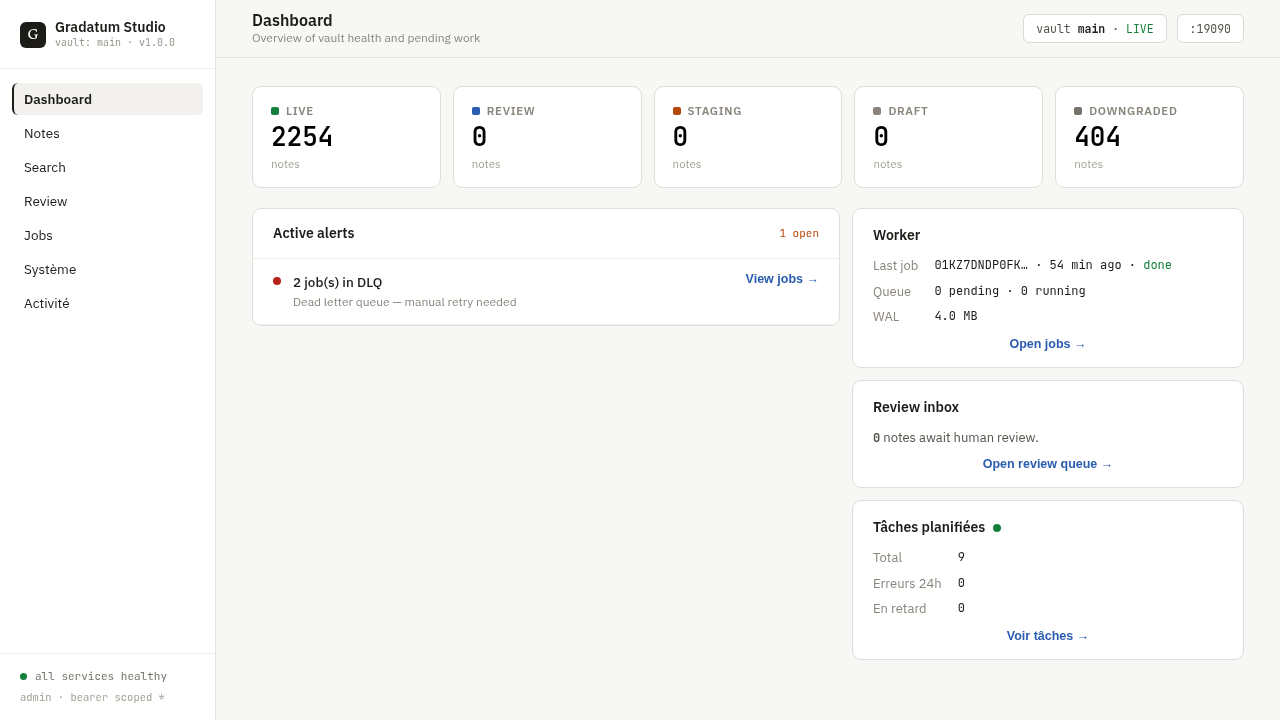
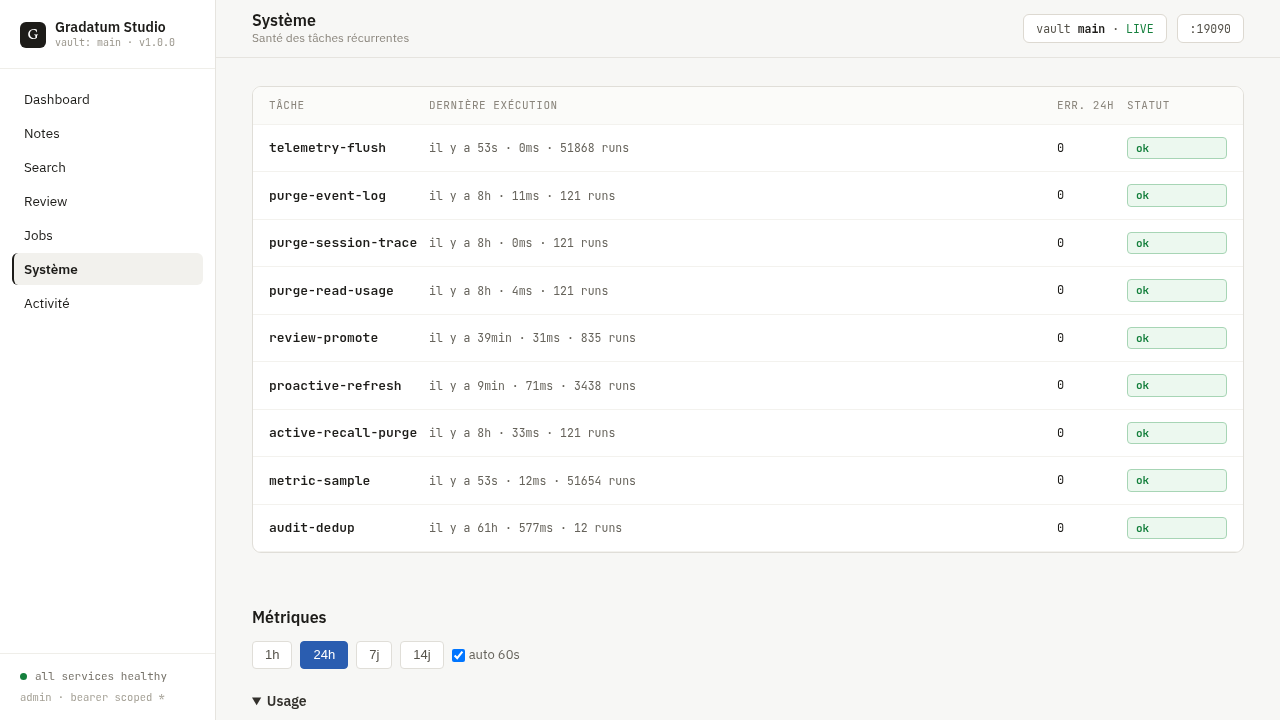
The Studio is the control surface of the Vault — a self-hosted dashboard with live metrics, a note browser with inline markdown, a scored search panel, a review queue and a job monitor. Your memory, on your hardware.
Roadmap — fifteen versions, four milestones
v0.1.0 · architecture foundation BRONZE Architecture Foundation
✓ SHIPPED
BRONZE Architecture Foundation
✓ SHIPPEDBefore you can build a useful memory layer, you need a store that actually works. v0.1.0 ships a functioning knowledge base — write, read, search — accessible over HTTP and MCP from day one. It lays the structural foundations that every later version builds on: pluggable storage interfaces, note integrity guarantees, and enough test coverage to deploy with confidence.
explore shipped features →- Working knowledge store — read, write, search, first deployment v0.1.0-alpha.0→5 2026-04
- Accessible over HTTP and MCP — any client can connect without custom integration v0.1.0-alpha.5 2026-05-07
- Search hardened — full-text and semantic results fused, accuracy improved v0.1.0-alpha.7→10 2026-05
- Dependencies updated — no known vulnerabilities in the supply chain v0.1.0-alpha.10-bumps.1 2026-05
- Search ranking improved — results reordered by relevance, not just keyword match v0.1.0-alpha.11→13 2026-05
- Migrated to gradatum as its own primary store — dog-fooding from day one v0.1.0-alpha.13 2026-05-25
- Auth tokens validated more strictly — future-dated tokens rejected v0.1.0-alpha.14 2026-05-28
- Agent skills shipped — gradatum can remind itself what it knows and search its own vault gradatum-skills v0.1.0 2026-05-25
- Note titles always resolve correctly — no more missing titles in search results v0.1.0-alpha.15 2026-05-28
- Alpha series closed — stable enough for early adopters v0.1.x closing 2026-05-29
v0.2.0 · job infrastructure + observability BRONZE Job Infrastructure + Observability
✓ SHIPPED
BRONZE Job Infrastructure + Observability
✓ SHIPPEDGradatum processes notes asynchronously — curation, embedding, distillation all run in the background. Without a reliable job engine, these tasks would silently fail and leave the vault in an inconsistent state. v0.2.0 ships that engine: background jobs survive restarts, failures are captured and retried rather than dropped, and every running task is visible in real time. This infrastructure is what makes every subsequent feature safe to ship.
explore shipped features →- Background job engine wired — tasks run reliably in the background without blocking the API v0.2.0 2026-05-29
- Failed jobs captured in a dead-letter queue — nothing is silently lost, retries are configurable v0.2.0 2026-05-29
- Job status visible over HTTP with live push updates — operators see what is running and why v0.2.0 2026-05-29
- Tagged — Bronze milestone, public OSS release v0.2.0 2026-05-29
v0.3.0 · storage traits + event-log + secrets di BRONZE Storage Traits + Event-Log + Secrets DI
✓ SHIPPED
BRONZE Storage Traits + Event-Log + Secrets DI
✓ SHIPPEDA knowledge store that is locked to a single database is a dead end. v0.3.0 separates the document layer, the search index, and the vector store into independent, swappable components — you can replace any one of them without rewriting the rest. It also fixes a critical bug where every server restart would invalidate all live sessions, and introduces a built-in model proxy so LLM calls are routed, reranked, and fully cost-attributed without a separate service.
explore shipped features →- Storage split into three independent layers — swap the database, search index, or vector store without touching the rest v0.3.0 2026-06-01
- Every LLM call logged with cost attribution — know exactly what each operation spent v0.3.0 2026-06-01
- Built-in LLM proxy and reranker — route model calls and reorder results by relevance without a separate service v0.3.0 2026-06-01
- Notes automatically tagged by memory type (episodic, semantic, procedural) — no LLM inference required, fully deterministic v0.3.0 2026-06-02
- Auth key survives server restarts — sessions no longer expire unexpectedly on reboot v0.3.0 2026-06-02
- Tagged — 28 crates, 1088 tests PASS, Bronze 3rd milestone v0.3.0 2026-06-02
- Parallel workers no longer deadlock under concurrent job load v0.3.3 2026-06-02
- Search results always show their title — no more blank note titles in results v0.3.4 2026-06-03
- Semantic search results enriched with title and excerpt — easier to scan at a glance v0.3.5 2026-06-03
- First public OSS release: source on GitHub, 28 crates published on crates.io (Apache-2.0) v0.3.6 2026-06-05
- Read and write reliability fixed: search titles persist, notes retrievable by ID, internal links reconcile correctly v0.3.7 2026-06-05
Memory layer
v0.4.0 → v0.5.1 — Completes the durable memory store: note history, temporal decay, semantic forget, VaultScope addressing, distillation, and MCP-native querying. Access is authenticated with a server-issued API key; multi-user isolation and remote client access are still ahead on the roadmap. The queryable, sovereign memory store that other systems — and eventually gradatum itself — will build on.
v0.4.0 · vault core — durable memory layer Vault Core — Durable Memory Layer
✓ SHIPPED
Vault Core — Durable Memory Layer
✓ SHIPPEDA store that only appends is not enough — you need to know what you can trust, recover from mistakes, and keep the vault from growing unbounded. v0.4.0 completes the memory layer: every note carries a trust score, a full edit history, and stable internal links that survive renames. Notes can be intentionally forgotten with progressive decay, and concurrent writes are always safe. This is the version that turns a write-only store into a durable, queryable memory.
explore shipped features →- Every note carries a trust score based on its origin — search results rank sources you can verify higher v0.4.0 2026-06-06
- Internal links between notes are stable — rename a note without breaking the references that point to it v0.4.0 2026-06-06
- Concurrent edits are safe — two writers on the same note at once get a clear conflict error, not silent data loss v0.4.0 2026-06-06
- Full edit history kept for every note — restore any previous version at any time v0.4.0 2026-06-06
- Tagged — 28 crates, 1178 tests PASS, durable write milestone v0.4.0 2026-06-06
- API never panics on bad input, all public docs written, SECURITY.md published, first crates.io + GitHub release v0.4.1 2026-06-06
- Write response now returns the note ID, demote-note returns a clear 404 when the note does not exist v0.4.2 2026-06-07
- Notes can be intentionally forgotten (with a dry-run preview), history pruning is configurable, multimodal input supported in the gateway v0.4.3 2026-06-10
v0.4.3 · addressing & query scoping — multi-vault foundation SILVER Addressing & Query Scoping — Multi-Vault Foundation
✓ SHIPPED
SILVER Addressing & Query Scoping — Multi-Vault Foundation
✓ SHIPPEDMulti-vault deployments need a unified way to address data across vaults and agents without per-job coordination. v0.4.3 ships that abstraction: VaultScope gives every background job a composable, deterministic address; Semantic Forget completes the data lifecycle with intentional deletion and decay; and Temporal Index adds chronological querying so agents can reason about when events happened and in what order.
explore shipped features → v0.5.2 · static code index + temporal queries + observability SILVER Static Code Index + Temporal Queries + Observability
✓ SHIPPED
SILVER Static Code Index + Temporal Queries + Observability
✓ SHIPPEDMemory without code awareness is half the picture. v0.5.2 adds a code index built directly from source — no LLM, no hallucination — so gradatum can answer "where is this function?" as reliably as "what was decided last week?". The index updates in milliseconds when files change, and stays in a separate store so it never pollutes the knowledge vault. A temporal index foundation enables time-aware queries: agents can reconstruct decision timelines and detect sequencing contradictions without external tools. This version also ships encrypted connections natively and makes it possible to know for certain that a topic is absent, not just unranked.
- Edit a note in place without creating a new version — conflicts detected automatically if two writers race v0.5.0 2026-06-12
- Every agent action logged for 90 days — audit what ran, when, and what it touched, without storing personal data v0.5.0 2026-06-12
- Search can now confirm a topic is truly absent — not just "nothing ranked high enough" v0.5.1 2026-06-13
- Browse notes in chronological order, filter by date range — see what was written before or after a given moment v0.5.1 2026-06-13
- Codebase indexed from source — find any Rust function, struct, or file by name or keyword, no LLM required v0.5.2 2026-06-13
- Code search by symbol, free text, or file path — optionally include the full source body in results v0.5.2 2026-06-13
- Index updates only what changed — re-indexing after an edit takes milliseconds, not seconds v0.5.2 2026-06-14
- Encrypted connections enabled natively — no reverse proxy required for TLS v0.5.2 2026-06-14
- Tagged — 31 crates, 1925 tests PASS, source on GitHub (Apache-2.0) v0.5.2 2026-06-15
v0.5.5 · foundation polish SILVER Foundation Polish
✓ SHIPPED
SILVER Foundation Polish
✓ SHIPPEDBefore opening gradatum to external clients via MCP, the foundation needs to be verifiably clean. v0.5.5 closes that window: the health endpoint now reports the exact running version and real queue state so there is no ambiguity about what is deployed. No new user-facing features — the goal is a baseline you can audit and depend on before the next chapter begins.
v0.6.0 · queryable memory store — mcp-native backend SILVER Queryable Memory Store — MCP-Native Backend
✓ SHIPPED
SILVER Queryable Memory Store — MCP-Native Backend
✓ SHIPPEDUntil now, gradatum was only usable through its own agent. v0.6.0 opens the vault to any MCP-compatible client — Claude Code, IDEs, custom agents — over a standard HTTP connection, with no sidecar process or protocol shim. The deliberate choice here: make the store useful to others first, then build gradatum's own context layer (v0.7.0) on top of the same interface everyone else uses.
explore shipped features → v0.6.4 · studio hardening + security baseline SILVER Studio Hardening + Security Baseline
✓ SHIPPED
SILVER Studio Hardening + Security Baseline
✓ SHIPPEDBefore a first public release, you owe it to users to be honest about what you are shipping. v0.6.4 is that honesty pass: a deep correctness audit surfaced twelve real bugs — including a regression that made some notes undeletable — and a security review tightened the admin UI to short-lived sessions, a strict content policy, and proper request size limits. The code index now covers five languages. This is the version that earns the right to be called stable.
v0.6.5 · project-map management stabilization SILVER Project-Map Management Stabilization
✓ SHIPPED
SILVER Project-Map Management Stabilization
✓ SHIPPEDThe project-map feature (structured feature lifecycle tracking with typed wikilinks as a canonical vault section) is now stabilized. v0.6.5 ships the complete feature cycle — release axis (roadmap / planned / released), deterministic duplicate detection, and a fail-closed CI gate. The public roadmap is reconciled to code ground-truth: CHANGELOG and git tags are now the authority, not separate documents. No new user-facing features — hardening and tooling before the context layer arrives in v0.7.0.
v0.6.6 · anthropic-compatible local endpoint SILVER Anthropic-Compatible Local Endpoint
planned
SILVER Anthropic-Compatible Local Endpoint
plannedClaude Code and other Anthropic-API agents expect a /v1/messages endpoint. v0.6.6 ships exactly that — a local gateway that speaks the Anthropic Messages API and routes every call to a model running on your own hardware. The point is concrete: point Claude Code at gradatum and it runs end-to-end locally, with no request ever leaving your machine.
Context & recall
v0.7.0 → v1.0.0 — Context assembly, proactive recall, identity, temporal search, and studio observability. v0.7.1–v0.7.5 are internal development milestones, published together as v0.7.6; v1.0.0 freezes the public API contracts and adds multi-user access with per-identity scopes.
v0.7.0 · memory layer + context assembly Memory Layer + Context Assembly
✓ SHIPPED
Memory Layer + Context Assembly
✓ SHIPPEDA store that answers queries on demand is still passive. The real value is a system that knows what is relevant before you ask — one that remembers what you worked on yesterday, surfaces the decision you forgot last month, and assembles exactly the right context before sending anything to a model. v0.7.0 is that layer: gradatum stops treating each session as stateless and starts reasoning over everything it has accumulated, on your hardware, across time.
v0.7.1 · active recall Active Recall
✓ SHIPPED
Active Recall
✓ SHIPPEDMemory is only useful if you can retrieve it. v0.7.1 adds proactive retrieval: gradatum autonomously surfaces relevant notes before you ask, recording which surfaced notes are actually used and bringing those decisions into context automatically.
v0.7.2 · context efficiency Context Efficiency
✓ SHIPPED
Context Efficiency
✓ SHIPPEDMore context is not always better. v0.7.2 optimizes what gets included in each decision: only the most relevant notes are assembled, irrelevant context is pruned, and the quality of assembled memory improves measurably. This is where the vault stops being verbose and starts being precise.
v0.7.3 · identity — soul notes & acl Identity — Soul Notes & ACL
✓ SHIPPED
Identity — Soul Notes & ACL
✓ SHIPPEDEach agent has its own identity: a soul note that captures its invariants, operational gates, and personality. v0.7.3 ships this as a protected vault section. Every agent can store and retrieve its own identity; enumeration is hidden from unprivileged callers; reads and writes are guarded by per-agent JWT binding. This is the foundation for multi-agent reasoning.
v0.7.4 · temporal search & decay Temporal Search & Decay
✓ SHIPPED
Temporal Search & Decay
✓ SHIPPEDMemory fades over time — and sometimes intentionally. v0.7.4 adds temporal search with from/to filters so agents can reason about what happened before or after a specific date. Recency decay down-weights stale notes in relevance scoring, keeping the vault focused on what still matters.
v0.7.5 · studio observability Studio Observability
✓ SHIPPED
Studio Observability
✓ SHIPPEDYou cannot improve what you cannot see. v0.7.5 ships three observability features: real-time background task health, operational metrics charts, and a session activity trace browser — all in the admin studio. Operations are now transparent.
v0.7.6 · memory validation — deterministic quality gates Memory Validation — Deterministic Quality Gates
✓ SHIPPED
Memory Validation — Deterministic Quality Gates
✓ SHIPPEDGood memory requires good judgment. v0.7.6 ships a deterministic distillation quality gate: every note summary is scored on grounding (cosine similarity to source), importance factors, and penalty functions. Low-quality summaries are tagged and degraded, never silently dropped. Identity ACL is hardened with privilege checks on every read and write.
v0.8.0 · vault stability — reversible deletion & hygiene Vault Stability — Reversible Deletion & Hygiene
⚡ IN PROGRESS
Vault Stability — Reversible Deletion & Hygiene
⚡ IN PROGRESSDeleting a note used to mean losing it. v0.8.0 turns on-demand delete into an archival operation: the note's Markdown and its history move under an archive tree, a durable JSONL tombstone is written before the cascade, and the note stays recoverable until a configurable 60-day retention deadline, after which a registry-driven GC destroys it. Restoring re-indexes the note as pending-review, so it re-enters the curator instead of going straight back to live. The whole archive lifecycle sits behind an operator-only CLI on a loopback admin namespace — agents can list archives over MCP but never delete, restore, or purge. The same train is set to add an opt-in vault audit and deduplication job, curator threshold tuning, and qualified method-call resolution in the code index — still planned within the v0.8.0 line.
v1.0.0 · production baseline GOLD Production Baseline
✓ SHIPPED
GOLD Production Baseline
✓ SHIPPEDAPI stability is a promise, not a feature. v1.0.0 is the version where gradatum makes that promise: the public contracts freeze, semver guarantees kick in, and anything built on top will not break without explicit notice. The Agent Layer reaches production form: gradatum-engine is a formalised install component (--with-engine / --with-gateway), the gateway routes all inference behind one alias, and the full six-binary stack deploys through Docker with network isolation. Multi-tenant isolation is hardened on the production queue path — stale-lease recovery, JWT iss/sub validation, tenant-scoped revocation — proven over 30 days of continuous operation with per-identity access scopes.
v2.0.0 · identity hardening & object storage Identity Hardening & Object Storage
✓ SHIPPED
Identity Hardening & Object Storage
✓ SHIPPEDv2.0.0 closes the 1.x line: identity is now strictly credential-derived — no default identity, no client-declared author, no silent fallback. Vault storage gains an S3-compatible object backend as an alternative to the local filesystem, and the startup restriction that refused to run on a network filesystem is removed — that trade-off is now the deploying operator's decision. Link-edge reconciliation repairs notes whose recorded links drifted from their current body. This release breaks public Rust API contracts (trait signatures, an error variant removed, a new required field), which is why it ships as a SemVer major rather than a minor.
v2.4.0 · personal-data marking, acl hardening & container packaging Personal-Data Marking, ACL Hardening & Container Packaging
✓ SHIPPED
Personal-Data Marking, ACL Hardening & Container Packaging
✓ SHIPPEDv2.4.0 gives every note a personal-data detection pass at write time — deliberately report-only, so an existing deployment behaves exactly as before until an operator activates a category. Marked notes carry two reserved tags, disappear from the search results of consumers who may not see them, and a false positive can be lifted by an administrative review — the only way to declassify a note. The ACL preset format is hardened with a dedicated validation command, the 2.3.1 → 2.4.0 upgrade path is now exercised end to end by an automated CI harness, and the product ships its first container image — a small, non-root, health-checked build published to the internal registry.
- Personal-data detection frontier ships, report-only — a note write is scanned once, and nothing depends on the answer v2.4.0 2026-09-16
- Marked notes carry two reserved tags and leave the search results of unauthorized consumers, while remaining readable by anyone who can already name them v2.4.0 2026-09-16
- A false positive can be lifted by an administrative review — the only path able to declassify a note durably v2.4.0 2026-09-16
- Note listing gains an exact-tag filter, and a truncation bug that dropped tagged notes from sparse pages is fixed v2.4.0 2026-09-16
- ACL preset format hardened — a removed configuration key, and an operator command to validate a preset before deploying it v2.4.0 2026-09-16
- The 2.3.1 → 2.4.0 upgrade is now exercised end to end by an automated CI harness, with an operational upgrade guide v2.4.0 2026-09-16
- First container image ships — multi-stage, non-root, a measured health check, published to the internal registry v2.4.0 2026-09-16
- Engine preflight now shares its validation with the running service, and the worker health probe no longer conflates a full mailbox with a real backlog v2.4.0 2026-09-16
- CI build directories are now bounded, closing a disk-exhaustion loop on the build fleet v2.4.0 2026-09-16
- Tagged — 28 crates published, 4,796 tests PASS v2.4.0 2026-09-16
v2.5.0 · privacy sidecar, fail-closed acl & queue erasure Privacy Sidecar, Fail-Closed ACL & Queue Erasure
✓ SHIPPED
Privacy Sidecar, Fail-Closed ACL & Queue Erasure
✓ SHIPPEDv2.5.0 ships the whole personal-data detection frontier as a complete, inert unit: gradatum-privacy gains a confined out-of-process sidecar detector reached over a unix socket, the masking mode that rewrites every passage it marks, and the [privacy] wiring that turns thresholds, categories and exceptions into a decision — none of it marks, rewrites or refuses anything until an operator activates a category, which stays deferred to 2.6.0. Masking mode is opt-in and destructive: switching it on purges the version history of every note it rewrites, and a one-shot history-purge command reaches what an earlier switch left behind. Two ACL gates close a fail-open gap — a preset that is present but cannot be loaded now refuses to start the server instead of falling back to deny-all in silence, and acl validate names every consumer whose read patterns hold no positive pattern. The job queue's terminal payloads are now erased physically, in bounded batches, on a schedule, and the release gate's semver check now asserts allowed behaviour per version rank instead of two hard-coded anchor entries. The 2.4.0 → 2.5.0 upgrade guide documents every one of these changes for an operator moving a live deployment.
- The personal-data detection frontier ships complete and inert — sidecar detector, masking mode and [privacy] wiring all present, no category activated by default v2.5.0 2026-09-17
- A sidecar detector for personal-data recognition runs out of process behind a unix socket, confined and supervised, and a call that does not complete is never reported as a scan that found nothing v2.5.0 2026-09-17
- Masking mode rewrites every marked span and is refused at load unless at least one activated category sits above a zero threshold v2.5.0 2026-09-17
- A masking write destroys the note's whole version history, and privacy history-purge reaches the snapshots an earlier switch to mask left behind v2.5.0 2026-09-17
- An ACL preset that is present but cannot be loaded now refuses to start the server, instead of falling back to deny-all in silence v2.5.0 2026-09-17
- acl validate names every consumer whose read patterns hold no positive pattern — a preset that reads nothing now says so v2.5.0 2026-09-17
- The job queue's terminal payloads are erased physically, in bounded batches, on a schedule, instead of only logically v2.5.0 2026-09-17
- The release gate's semver check now asserts behaviour per version rank, closing the last hard-coded anchor entries v2.5.0 2026-09-17
- Tagged — 28 crates published, 5,002 tests PASS v2.5.0 2026-09-17
v2.6.0 · personal-data category activation Personal-Data Category Activation
planned
Personal-Data Category Activation
plannedv2.6.0 is planned to turn the personal-data marking pass shipped inert in 2.5.0 into an active one: a measurement campaign informs which categories are safe to turn on, category by category, rather than activating on an uncalibrated threshold. The CI build-directory observation windows opened alongside the 2.5.0 garbage-collection work are expected to close on a normal-regime measurement, not on more code.
v3.0.0 · multimodal, consolidation & sovereign agent runtime PLATINUM Multimodal, Consolidation & Sovereign Agent Runtime
planned
PLATINUM Multimodal, Consolidation & Sovereign Agent Runtime
plannedText was always just the starting point. v3.0.0 extends gradatum to images, audio, and documents — and introduces long-horizon memory consolidation, where the system compresses and learns from its own history over time. This version also ships gradatum-code: a terminal agent that reasons over your codebase using vault memory, recalls past decisions, and executes tasks end-to-end on local hardware — nothing leaves your machine. This is a breaking change by design: the chat API is rebuilt to handle multimodal input natively, completing gradatum's arc from a local knowledge store to a full cognitive infrastructure.
Pre-built binaries, crates.io, or build from source.
# clone
git clone https://github.com/gradatum/gradatum
cd gradatum

# build + init + install systemd units, in one idempotent script
sudo bash scripts/install-gradatum-services.sh --build

# check it's running (system-scoped unit, not --user)
sudo systemctl status gradatum-server# write a note (vault_write)
curl -X POST http://localhost:19090/api/v1/vault_write \
-H "Authorization: Bearer $GRADATUM_BEARER" \
-H "Content-Type: application/json" \
-d '{"locus":"projecta/backend","section":"decisions","body":"Use ULID for stable note identity"}'
# search across loci
curl http://localhost:19090/api/v1/vault_search \
-H "Authorization: Bearer $GRADATUM_BEARER" \
-d '{"query":"ULID identity","locus":"projecta/*"}'# .mcp.json — gradatum-server serves MCP natively, no separate bridge process
{
"mcpServers": {
"gradatum": {
"type": "http",
"url": "http://127.0.0.1:19090/mcp",
"headers": { "Authorization": "Bearer ak_your_api_key" }
}
}
}
# Or via HTTP directly (API)
curl http://localhost:19090/health
curl http://localhost:19090/api/v1/vault_search \
-d '{"query":"ULID","locus":"projecta/*"}' v2.5.0 — current release. Source on
GitHub (Apache-2.0);
28 of the 34 workspace crates on crates.io at v2.5.0. The other six are not part of the distribution: the CLI, the bench and parity test harnesses, gradatum-mcp-stub and gradatum-sdk-rs. Three of them are still visible on crates.io at older, frozen versions — gradatum-cli 0.7.6, gradatum-mcp-stub 1.0.0 and gradatum-sdk-rs 2.0.0 — and no longer track releases.
Pre-built binaries (server / llm) on
GitHub Releases
are at v2.5.0. SemVer since v1.0.0, with documented exceptions: the previous minor release renamed a doc-hidden Rust item (ConfigError::PrivacyMaskUnavailable → ConfigError::PrivacyMaskWithoutActivation, in a #[doc(hidden)] module of gradatum-server) — invisible to the public-api surface gate, but still a break for a consumer matching the old variant directly; see the CHANGELOG. v2.5.0 behaviour change: a configured-but-unusable ACL preset now refuses to start the server, instead of silently falling back to deny-all (see the UPGRADING guide). The 2.3.1 → 2.4.0 line made ACL read patterns deny-by-default — see the 2.3.1 → 2.4.0 upgrade guide. Project-map registry operators had breaking changes in v2.2.0, covered in the 2.1.0 → 2.2.0 upgrade guide. Moving from 2.0.0 first needs the 2.0.0 → 2.1.0 upgrade guide. See the
Install page for all deployment profiles.